
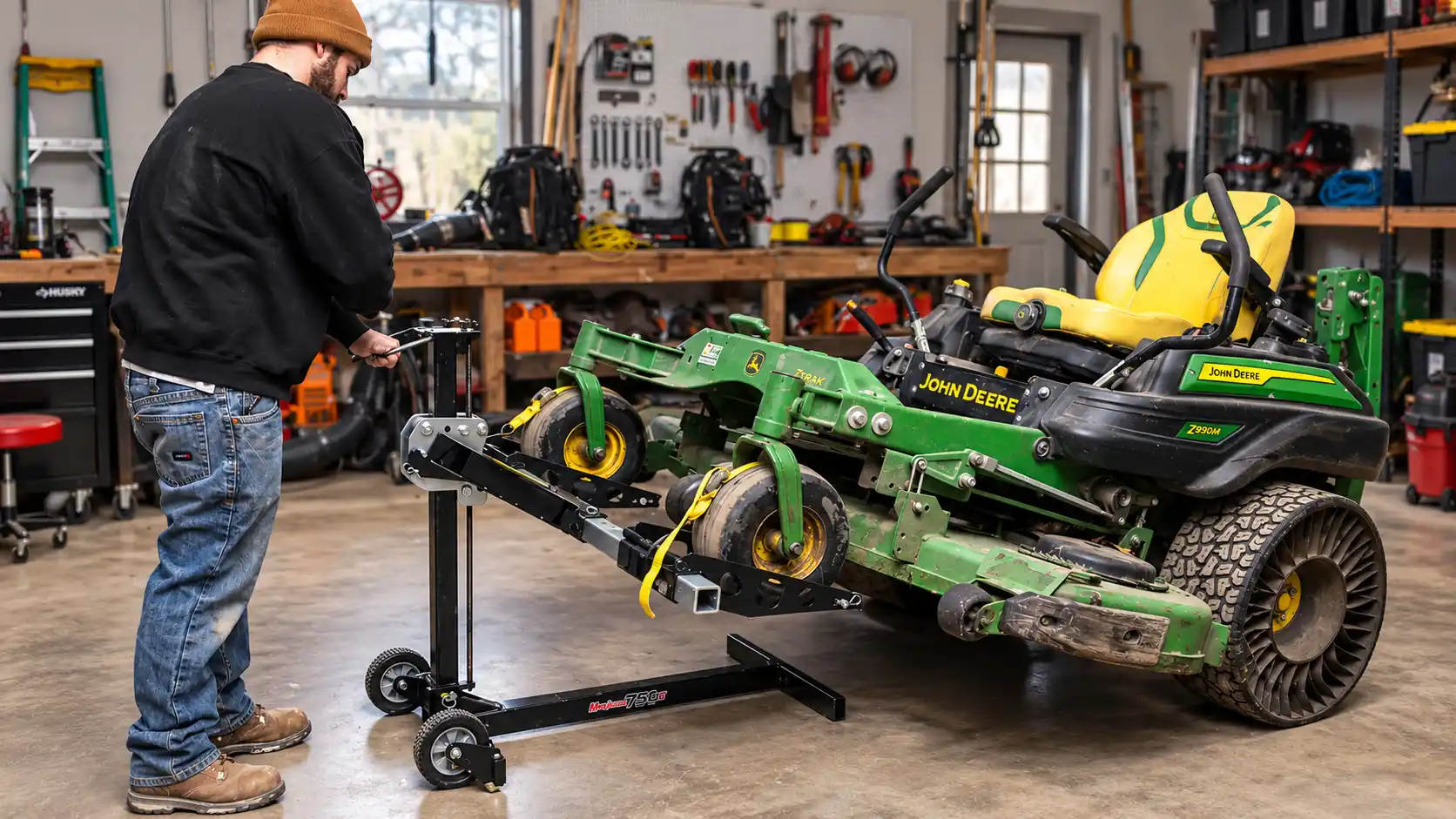
A dedicated mower lift turns one of the riskiest parts of DIY maintenance, manually lifting or propping up a machine you can’t fully control, into a simple, stable, one-person task. That matters more than it might seem: OSHA and the Bureau of Labor Statistics identify lifting-related overexertion as the leading cause of workplace back and shoulder injuries. The right setup doesn’t just make maintenance easier. It takes the riskiest part of the job off the table entirely.
Finding the best lawn mower lift for your garage isn’t really about specs on a page. It’s about how well a lift fits your actual garage, your actual mower, and the way you actually work.
Choosing the Best Lawn Mower Lift Starts with Your Garage Setup
Garage space is one of the most overlooked factors in this purchase, and it’s usually the first thing that goes wrong. Picture a typical two-car garage with a riding mower already parked on one side and a workbench along the back wall; there’s often less usable floor space left than it looks like on paper, and a lift with a 62.5-inch wheel span needs real room to open up and still let you walk around it while working.
MoJack’s own lineup ranges from an 18.5-inch minimum wheel span on the HDL up to 62.5 inches on the 750 XT and PRO, a real difference in the physical footprint you’re committing to, not just a spec on paper. A lift that technically fits and a lift that actually works in your space are two different things, and the difference usually only shows up after the purchase, not before.
Choose the Right Lawn Mower Lift Based on Your Mower Type
Not every lift is built for every mower, and matching the two correctly starts with understanding what you’re actually lifting. Riding mowers generally need higher weight capacity and a stable base, since a full-size garden tractor puts real load on the frame. Zero-turn mowers need wider compatibility and secure positioning, since their wheelbase and weight distribution differ from a tractor.
Push mowers need something far simpler, a lighter lift with a quicker setup, since there’s no comparable weight to manage. One detail worth knowing before you buy anything: when lifting a zero-turn mower, you’re only supporting about 30 percent of its total weight, while a tractor-style mower puts closer to 50 percent of its weight on the lift. That difference alone can rule out or confirm a specific model before you look at anything else. The MoJack Lift Compatibility tool matches your specific mower to the right lift, so you don’t have to guess.
Key Features That Define the Best Lawn Mower Lift for Your Garage
Weight capacity should comfortably exceed your mower’s actual weight, not just barely clear it, which is why MoJack’s own lineup spans 500 lbs on the HDL up to 750 lbs on the 750 XT and PRO rather than offering one fixed number for every mower. Lifting height needs enough clearance to complete maintenance tasks; blade changes and belt work both need real working room underneath, and the difference between a 24-inch lift and a 28-inch lift is often the difference between crouching and standing comfortably.
Frame construction determines whether a lift holds up season after season or starts flexing under repeated use; solid steel construction resists that kind of wear far longer than lighter-gauge alternatives. Safety features and a stable lifting angle round out the list, and they’re what separate a lift you trust from one you’re cautious around every single time.
Manual vs Hydraulic Lawn Mower Lifts: Which Should You Choose?
Manual lifts suit occasional use and smaller garages well, since they’re lower cost and simpler to operate without power tools. Hydraulic lifts make more sense for frequent maintenance and heavier mowers, since they lift faster and demand less physical effort per use. The locking mechanism varies by design too: a hydraulic locking bar on one model, a ratcheting safety lock on another, each engaging automatically at height so you’re never relying on the lifting mechanism alone to hold position while you work underneath.
The real question isn’t which type is better in the abstract; it’s whether your actual workload calls for convenience or built-in capacity. MoJack’s own comparison of the HDL, 750 XT, and PRO breaks down exactly this tradeoff across three real models, including lifting capacity, height, and mechanism side by side, useful if you’re weighing this decision against real specs rather than generalities.
How Garage Space and Layout Impact Your Lawn Mower Lift Choice
Measuring your actual floor space, including enough clearance to walk around the lift while working, comes first. Smooth flooring versus uneven concrete affects stability more than most buyers expect, and a lift that feels rock-solid on a level slab can feel different on an older, cracked garage floor.
Getting the mower onto the lift easily, without fighting alignment every time, is also a real daily-use factor, not just a one-time setup concern. None of this is about how the lift stores away; it’s about whether the space you actually have works with the lift once it’s in use, not just parked.
Common Lawn Mower Lift Buying Mistakes That Cause Frustration
Ignoring weight capacity limits is the most common mistake, and it’s easy to make when a lift looks sturdy enough at a glance. Choosing a lift that doesn’t actually fit your garage footprint is a close second, usually discovered only after delivery. Prioritizing price over usability and durability tends to backfire the same way a cheap tool always does: it works fine until the one time it doesn’t.
Overlooking safety features and locking systems is the highest-stakes mistake, since that’s exactly what OSHA’s injury data points to as the real risk in the first place. The Lift Compatibility tool exists specifically to catch the weight-capacity and fit mistakes before they become a returned box in your garage.
A Simple Way to Choose the Best Lawn Mower Lift for Your Needs
Start by measuring your actual garage space and storage area, since that number rules out or confirms options before you look at anything else. Next, confirm your mower type and weight, including whether you’re working with a zero-turn or a tractor-style mower, since that determines the real load the lift needs to handle.
From there, decide honestly how often you’ll actually use the lift; occasional seasonal maintenance calls for a different choice than frequent, ongoing work, and knowing every model carries the same two-year residential warranty takes some of the pressure off getting that guess exactly right. Finally, choose between manual and hydraulic based on that same honest answer, weighing the lower cost and simplicity of manual against the speed and reduced effort of hydraulic.
Where to Buy the Best Lawn Mower Lift for Your Garage
MoJack backs every lift, manual or hydraulic, HDL up through PRO, with the same 2-year limited warranty for residential use, well beyond a one-time purchase with no real backing behind it. Lifts are available not just directly but through Lowe’s, The Home Depot, Tractor Supply, and Cub Cadet dealers, giving homeowners and professionals a reliable option no matter how they prefer to shop.
That range of models, from simpler manual lifts to higher-capacity hydraulic options, means the right fit exists for a weekend homeowner and a working professional alike, not a single one-size-fits-all product. Pairing the right lift with the right accessories, like a deck scraper or workbench attachment, rounds out a setup built for real maintenance, not just occasional use.
Ready to Choose the Right Lift for Your Garage?
Choose a lawn mower lift that fits your garage, your mower, and your workflow, not just whatever looks sturdiest on a shelf. Explore MoJack’s full lineup to find a lift built for safety, real garage space, and the way you actually work on your mower.