
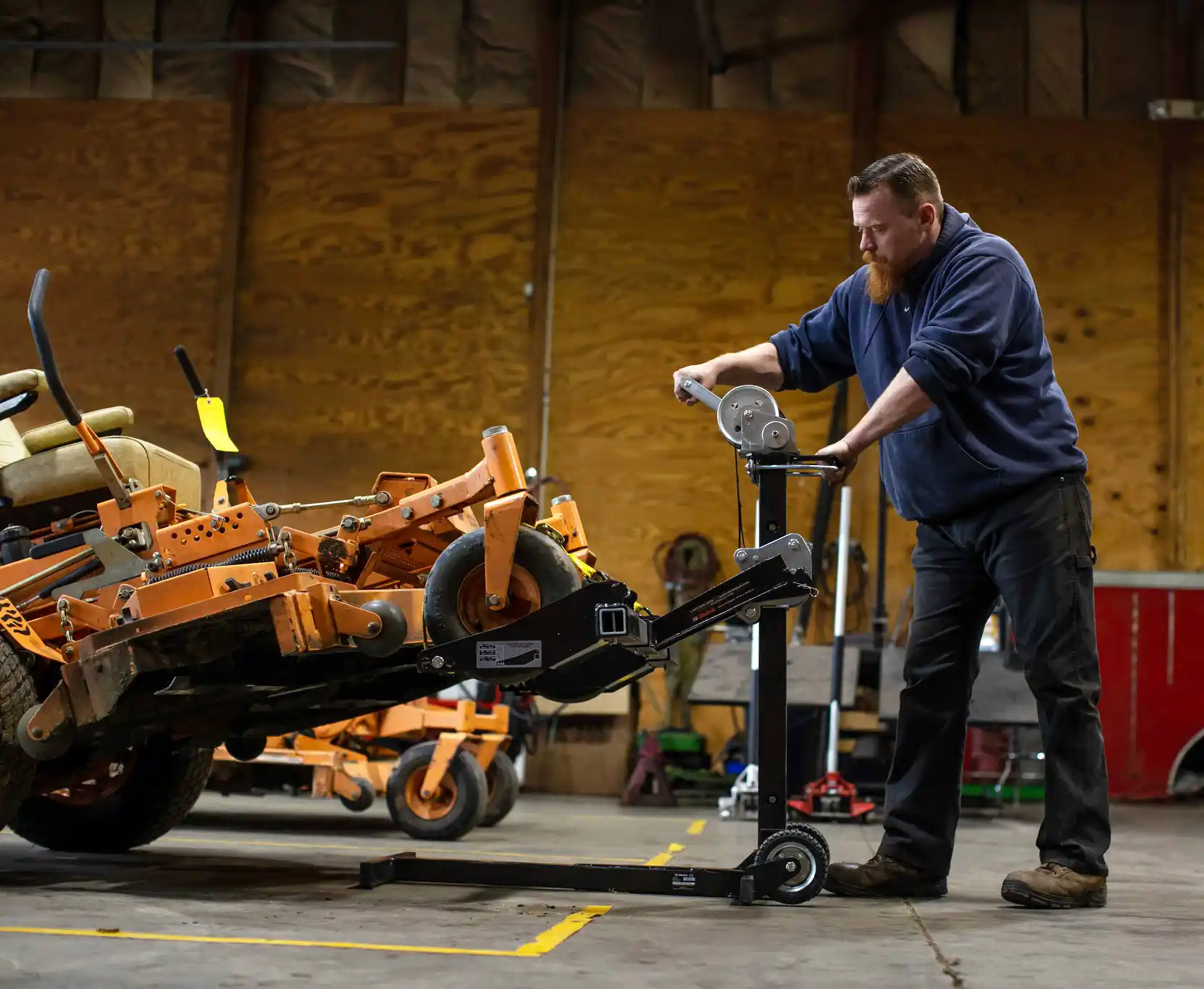
If you own a riding mower or zero-turn, you already know that getting underneath it is one of the least enjoyable parts of ownership. Tilting it by hand, propping it with a piece of lumber, or crawling around on the garage floor is not maintenance. It is a guessing game with your safety. A lawn mower lift changes that entirely.
Lawn mower maintenance can be more dangerous than most homeowners realize. A LawnStarter survey found that an average of 875 people visit the emergency room every day for yard work injuries, with hands and fingers among the most commonly hurt body parts. Using stable support equipment like a lawn mower lift can be a simple step toward safer routine maintenance.
When routine tasks like blade sharpening, deck cleaning, and belt inspection become difficult or unsafe to perform, they get skipped, and skipped maintenance shortens equipment life faster than almost anything else. A lawn mower lift makes those tasks safer, faster, and actually worth doing on a regular schedule. If you have been wondering whether one is worth it, this guide covers what a lawn mower lift is, how it works, and who genuinely benefits from having one.
What Is a Lawn Mower Lift (and What Does It Actually Do?)
A lawn mower lift is a piece of equipment designed to safely raise the front end of a riding mower or zero-turn mower off the ground and hold it in a stable position while you work. Unlike a car jack or improvised ramp, a mower lift is purpose-built for the specific dimensions, weight distribution, and lifting angles of mowing equipment.
Most lifts operate by rolling underneath the front of the mower and using a mechanical or hydraulic lifting mechanism to raise the deck to a comfortable working height. Once raised, locking mechanisms hold the mower securely in place so it cannot shift or fall while you are underneath it. The design keeps the mower stable at the correct angle for deck access without stressing components not designed to bear that load.
Compatibility varies by model. Most residential lifts are designed for standard riding tractors and zero-turn mowers, while some models also accommodate select push mowers. Weight capacity is a key spec. Riding lifts raise approximately 50% of a tractor-style mower’s total weight, or about 30% for zero-turn models, since zero-turns are heavier in the rear. Knowing your mower’s weight before selecting a lift ensures you choose a model rated for the job.
The Real Reason People Use Lawn Mower Lifts
The most common answer is blade sharpening, and that alone makes a lift worth it for most homeowners. Dull blades do not cut grass cleanly. They tear it, which stresses the plant, increases fuel consumption, and puts unnecessary load on the engine. Getting to the blades without a lift means either tilting the mower by hand or crawling around on the floor trying to position a jack safely. With a lift, you roll it into place, raise the deck in seconds, and work standing up.
Deck cleaning is the second most common use. Grass buildup under the deck reduces airflow, causes uneven cutting, and can accelerate rust on the deck surface. Removing it properly means getting clear access to the underside, which is exactly what a lift provides.
Beyond those two tasks, a lift makes it practical to inspect and replace belts, check bearings and spindles, access grease points that are nearly impossible to reach from the side, and perform oil changes without awkward angles or spills. For homeowners who want to perform mower maintenance on their own schedule, rather than hauling equipment to a shop at every service interval, a lift makes those tasks straightforward.
Do You Actually Need One? Signs the Answer Is Yes
The clearest sign is that maintenance is not getting done because it is too difficult. If sharpening the blades requires half a day of setup, or you have been putting off deck cleaning because getting underneath the mower is genuinely unpleasant, those are the exact problems a lift solves. Mowers that go seasons without blade service or deck cleaning show it in cut quality and component wear long before owners realize why.
Improvised methods are the other dead giveaway. Wood blocks, bottle jacks, and car jacks are not designed for the shape or weight distribution of a riding mower, and none of them hold the mower securely while you are underneath it. If you have ever used one of these methods and felt uneasy about the stability, that instinct is correct.
Owning a riding mower or zero-turn automatically puts you in the target user group. If you are doing your own routine mower maintenance rather than taking the mower in for service, a lift is not optional equipment. It is the tool that makes the rest of the job possible. A quality mower lift is a one-time purchase, and sharpening blades with one takes a fraction of the time and none of the risk.
Types of Lawn Mower Lifts and Which One Fits Your Setup
Once you know you need a lift, the next question is which one. The right choice comes down to your mower type, how often you maintain it, and how much weight you need to lift.
Manual lifts use a hand crank or foot-assist mechanism. They are the most common choice for homeowners who maintain their own equipment a few times per season. The lifting action is controlled and deliberate, which makes them easy to use without a second person. The MoJack ZR350 and MoJack PRO fall into this category. The ZR350 is designed for blade sharpening, belt replacement, and debris removal on most residential riders and zero-turns, while the PRO uses a foot-assist design for hands-free raising.
Hydraulic lifts use a hydraulic cylinder, requiring significantly less physical effort. They are a better fit for frequent use, heavier mowers, or anyone who wants faster operation. The MoJack 550 and MoJack HDL are hydraulic options built for larger garden tractors and zero-turns with higher weight capacities.
Heavy-duty options like the MoJack XT 750 offer a 750-pound lift capacity and a foldable design for storage, making them well suited for larger residential mowers. If you service your mower twice a year, a manual model is a practical choice. If you are maintaining multiple machines or working weekly, a hydraulic model saves meaningful time every session.
Capacity matters more than most people expect. A lift rated for 350 pounds used on a 700-pound tractor is not just underpowered. It is unsafe. MoJack’s lift compatibility tool helps you identify the right model for your mower’s make, weight, and configuration. For a side-by-side breakdown of models, the MoJack model comparison guide walks through the differences in detail.
Why a Purpose-Built Lift Is Safer Than Any DIY Method
A mower lift is engineered specifically for the geometry of riding equipment. The cradle contacts the mower at the correct load points, the locking mechanism holds the raised position without drift or wobble, and the lifting angle is calculated for deck access rather than adapted from a tool designed for something else. No improvised method offers any of that.
For a full walkthrough on safely lifting a riding mower with proper equipment, MoJack’s guide covers the process step by step.
Where to Buy a Lawn Mower Lift
MoJack designs and builds mower lifts specifically for this job, with a range of models built for residential homeowners and zero-turn owners. Our lifts are available directly from MoJack and at major retailers including Lowe’s, Home Depot, Tractor Supply Co., and Cub Cadet dealers nationwide.
The MoJack lineup includes models from the ZR350 for standard residential use up to the XT 750 for heavier equipment, with hydraulic options and accessories for every setup. Free shipping is included on all MoJack lift orders.
Make Maintenance Safer, Faster, and Worth Doing
A lawn mower lift is not a luxury purchase for people who love spending time in the garage. It is the tool that makes routine maintenance practical enough to actually happen. When blade sharpening, deck cleaning, and belt inspection are easy to do safely, they get done, and mowers that are maintained on schedule last longer than those that are not. Browse the full MoJack lineup, use the lift compatibility tool to match a model to your mower, or compare options side by side to find the right fit.