
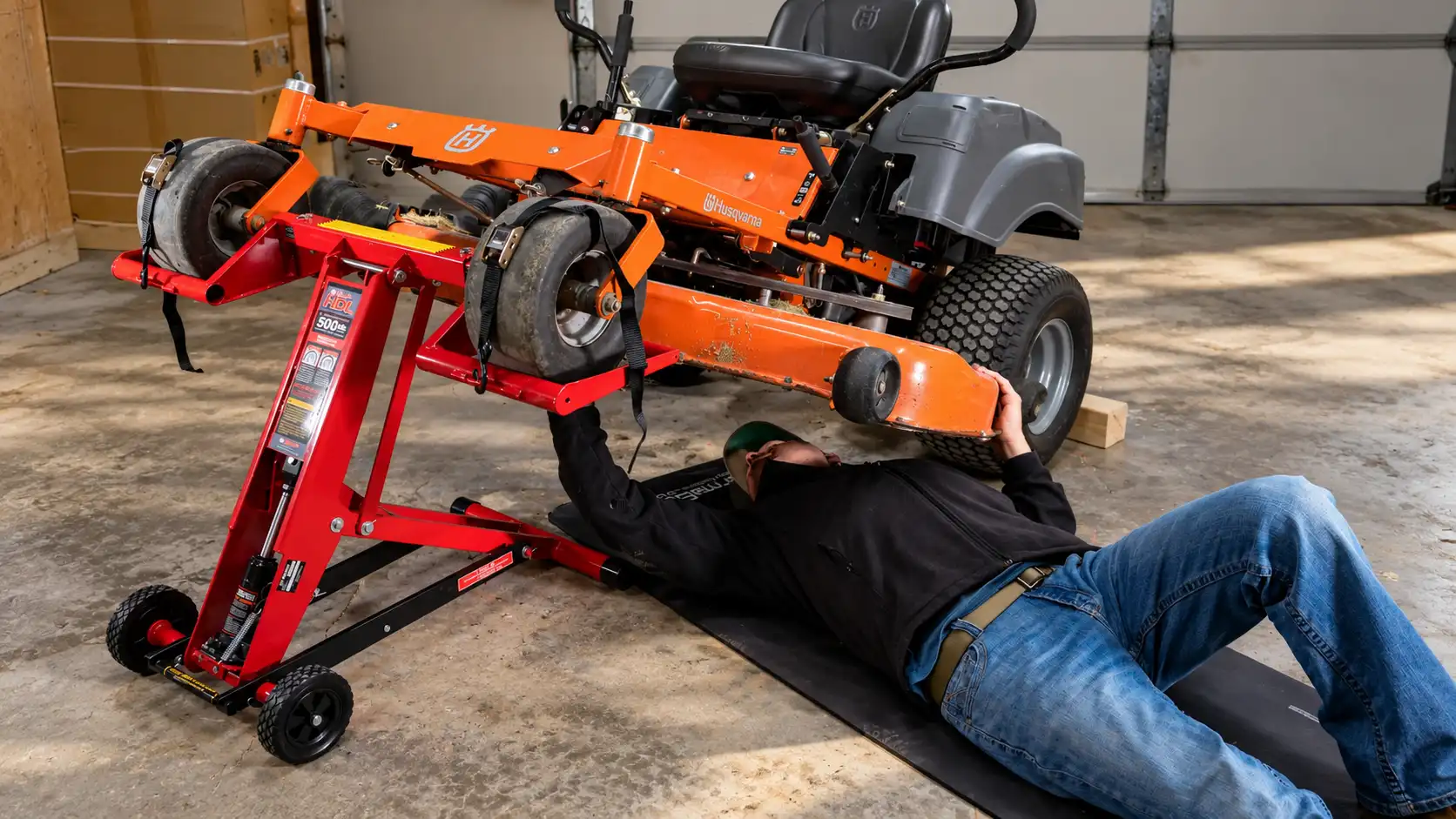
Picture a Saturday blade change. The front of the riding mower sits on two cinder blocks pulled from behind the shed, with a couple of scrap 2x6s filling the gap. It looks solid, so you slide underneath with a wrench. Plenty of homeowners have been right there, and learning how to lift a mower safely starts with seeing why that setup only looks stable. MoJack built its lifts around this exact moment, so nobody has to trust a pile of blocks again.
Swap stories in lawn equipment forums, and you’ll hear the same handful of methods: car ramps, homemade wooden ramps, a floor jack, even an engine hoist. Several owners admit the ramps ended up parked right where the deck needed to drop, and one tried hoisting the front of a heavy zero-turn by hand before calling it quits. On a vehicle restoration board, members recall blocks bursting apart under loads lighter than a car.
People reach for these fixes because they’re cheap and already sitting in the garage, which makes total sense. A Johns Hopkins study of national emergency department data puts lawn mower injuries at nearly 6,400 a year, a figure that covers all kinds of mower mishaps, not just lifting. The encouraging part is that lifting is one of the easiest things to get right, and the MoJack lineup offers a simple, safer replacement for each makeshift method.
1. Cinder Blocks and Wood Stacks
Concrete blocks are made to carry weight evenly from above, stacked inside a wall. Under a mower, the load usually lands on one edge or corner instead, and hollow blocks can crack or shift with little warning. Wood stacks bring their own surprises, since one warped board or a little sawdust on the floor is enough to let the pile slide. MoJack lifts replace that uncertainty with solid steel construction, built to sit on a flat, solid floor while you work.
There’s also nothing in a stack that locks. If a block shifts, the mower comes down with no warning. Every MoJack lift, whether you raise it by crank, winch, or hydraulics, locks into place at the height you choose and stays there.
2. Chain Hoists and Pulley Systems
Hoists are great at their real job: lifting a static load straight up, like an engine out of a bay. Working beneath one is a different job entirely. You’ll pull stubborn bolts, push a scraper across the deck, and torque blade nuts, and each movement nudges a load hanging from a single chain point.
That single chain point also ignores how a mower spreads its weight across its wheels and frame, so the machine can swing or rotate as you work. MoJack lifts support the mower from the floor up, leaving nothing overhead to sway.
3. Ramps Without Wheel Chocks
Ramps feel like a sensible middle ground, and they do get the front end off the floor. Without chocks behind the rear wheels, though, a mower can roll backward off the ramp, especially on a sloped driveway or a slick garage floor. Wheel chocks, the parking brake, and a pulled key go a long way toward keeping everything where it belongs.
Clearance is the other catch. A few inches of ramp height rarely leaves enough room to reach the blades comfortably, let alone pull a belt. A dedicated MoJack lift raises the front of the mower high enough for blade changes, deck cleaning, and belt work, the exact jobs these lifts were built to make easier.
4. Jack Stands Alone
Jack stands are trusted gear in any car garage, and for good reason. They’re designed for flat, rigid vehicle frames with clear lift points. Mowers offer narrow contact points instead: a front axle, a slim frame rail, or sometimes just the edge of a deck housing never meant to bear weight. A MoJack lift sidesteps that problem altogether.
When the weight isn’t centered on a stand’s small saddle, the mower can tip sideways, particularly once you start applying force underneath. MoJack’s guide on lifting a lawn mower by yourself explains where jack stands still earn a spot as backup support under the frame, and why a mower-specific lift is the better primary tool.
What a Proper Mower Lift Does Differently
Start with the locks. A good lift holds position mechanically, without you holding a handle or relying on hydraulic seals. MoJack mower lifts engage safety locks or locking pins at working height, so the lifting mechanism never carries the job alone.
Fit comes next. Wheel pads support the tires where the mower’s weight already sits, so the whole machine isn’t balanced on one small point. Options range from the EZ Max with its clutch and automatic safety system to the hydraulic MJ 550, rated up to 550 lbs, and the PRO with foot-assist lifting for bigger machines.
Then add a backup. Even with the locks engaged, the MoJack Safety Strap gives you a hold-down layer that keeps the mower snug against the lift. Sold as a pair and compatible with all MoJack lifts, it’s an easy upgrade to whichever lift you own.
Matching a Lift to Your Mower
Capacity is where good intentions can go sideways. Per MoJack’s compatibility guidance, a lift handles roughly 30 percent of a zero-turn mower’s total weight and roughly 50 percent of a tractor-style mower’s. That gap changes the math, so a lift that suits one style might be undersized for another.
Guessing on capacity is a safety risk on its own, since an overloaded lift can’t do what it was designed to do. The MoJack Lift Compatibility tool removes the guesswork: enter your machine’s weight and wheelbase, and it points you to the right lift. Once you’re set up, the walkthrough covers prep, engaging the safety locks, and slowly raising the mower. Have an unusual model? Customer service can help with that, too.
Ready to Lift Your Mower Safely?
Stop improvising with what’s lying around the garage. A mower lift built for the job keeps both you and your mower supported the right way. Shop MoJack mower lifts, or find your lift in a couple of minutes, and make your next maintenance session the easiest yet.